New institutions: Land Market
- Projects of colonization operated under a state-oriented private colonization model, which fundamentally relied on the establishment of a Land Market to expand the agricultural frontier in the Amazon.
- Surpluses with the learning by doing brought by immigrants: increased production driven by population growth
- The colonization projects were an expression of the existing Land Market, not the other way around.
- When this institution did not function effectively, particularly in conjunction with inadequate transportation infrastructure, colonization projects often failed to achieve their objectives, as exemplified by the Japanese colony of CAPEM.
Constraints
- Decrease deforestion ratio: Decreto n° 5.975/2006 and 50% reserve was adopted in 1989 due to Law n° 7.803/1989.
Figure 3 - Legal Amazon in Mato Grosso with coverture of land in millions of hectares
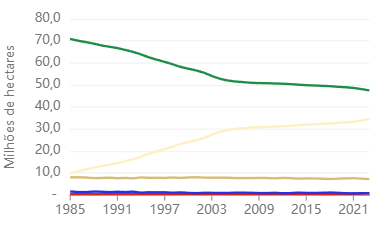
Legend:
| Forest | |
| Arbustive and herbace vegetation | |
| Non-vegetable areas | |
| Agro and cattle | |
| Water corps |
Source: BRASIL, 2023.
- Fiscal consolidation:
- Production and living infrastructure that frequently went unfulfilled
- Consequently, the Land Market could not fully regulate interaction, production, and transactional costs.
- It is reasonable to expect that institutional changes did not function flawlessly.